The Author
Ernest Hemingway (1899-1961)
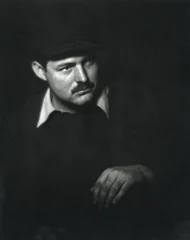 Ernest Hemingway in Paris, 1928. Photo courtesy of the John F. Kennedy Presidential Library and Museum, Boston
Ernest Hemingway may have been the most famous novelist in the English language during his lifetime. Idolized by readers, envied by fellow writers, and adored by many for the romantic lifestyle that he created for himself, Hemingway the writer must always be distinguished from Hemingway the public figure. The first was a sensitive and exacting artist; the second was a larger-than-life image maintained for tabloid consumption. As early as 1929, Dorothy Parker was moved to remark: "Probably of no other living man has so much tripe been penned or spoken."
The adulation that Hemingway inspired is not difficult to explain. By turns tough and tender, he lived a life of exuberant masculinity—which included hunting for big game in Africa, for Nazi submarines in his fishing boat off Key West, or for the best bar in Paris. He celebrated bullfighting, boxing, hunting, and even warfare as manly pursuits worthy of respect. His years were rife with adventurous accident, including an anthrax infection while on honeymoon in France, and two successive plane crashes on safari. Second-degree burns resulting from a bushfire accident prevented him from traveling to Sweden to accept the Nobel Prize. He won the Silver Medal of Military Honor in the First World War and the Bronze Star Medal in the Second.
A leader of the so-called "Lost Generation" and a Modernist, Hemingway's closest friendships included literary giants Ezra Pound, Gertrude Stein, and James Joyce. He was an intellectual and a celebrity, and one of the few Americans to find both roles congenial. He married four times and lived to see 18 of his works published. He died a millionaire, a close friend of movie stars such as Gary Cooper, and a winner of both the Pulitzer and Nobel prizes. In many ways, his career was the stuff of legends.
Such success did not, however, alleviate his personal struggles. For a man so publicly celebrated and revered, he could be curiously reticent—he wanted no biography written about his life, and he left a will that blocked any publication of his letters. His later years were marked by severe depression, for which he underwent electro-convulsive therapy. Suffering from acute paranoia, he believed for a time that federal agents were after him. Years of alcoholism and organ damage wreaked havoc on his body; digestive complications, high blood pressure, and failing eyesight troubled him constantly. Ernest Hemingway eventually committed suicide in 1961, following the path of his father and two siblings.